

美天旎
130‑111‑160

T Cell TransAct T 细胞激活剂
T cell activation via CD3 and CD28 with T Cell TransAct™. This stimulation reagent is ready-to-use for in vitro activation and expansion of human T cells. Its polymeric nanomatrix structure ensures gentle and efficient activation of resting T cells from PBMCs and of enriched T cell populations, while maintaining high viability.

产品简介
Background information
T Cell TransAct™ consists of a colloidal polymeric nanomatrix conjugated to humanized CD3 and CD28 agonists providing primary and co-stimulatory signals for an optimized and efficient T cell activation and expansion. The nanoscale structure of T Cell TransAct™ allows sterile filtration and excess reagent can be removed by centrifugation with following conventional supernatant replacement or simply by medium wash.
Polyclonal T cell expansion can be used when increased numbers of effector cells are required without the use of feeder cells or antigens, or when T cells are activated to enable gene modification.
Applications
In vitro stimulation and expansion of T cell populations, either from purified T cells or from PBMCs.
产品参数
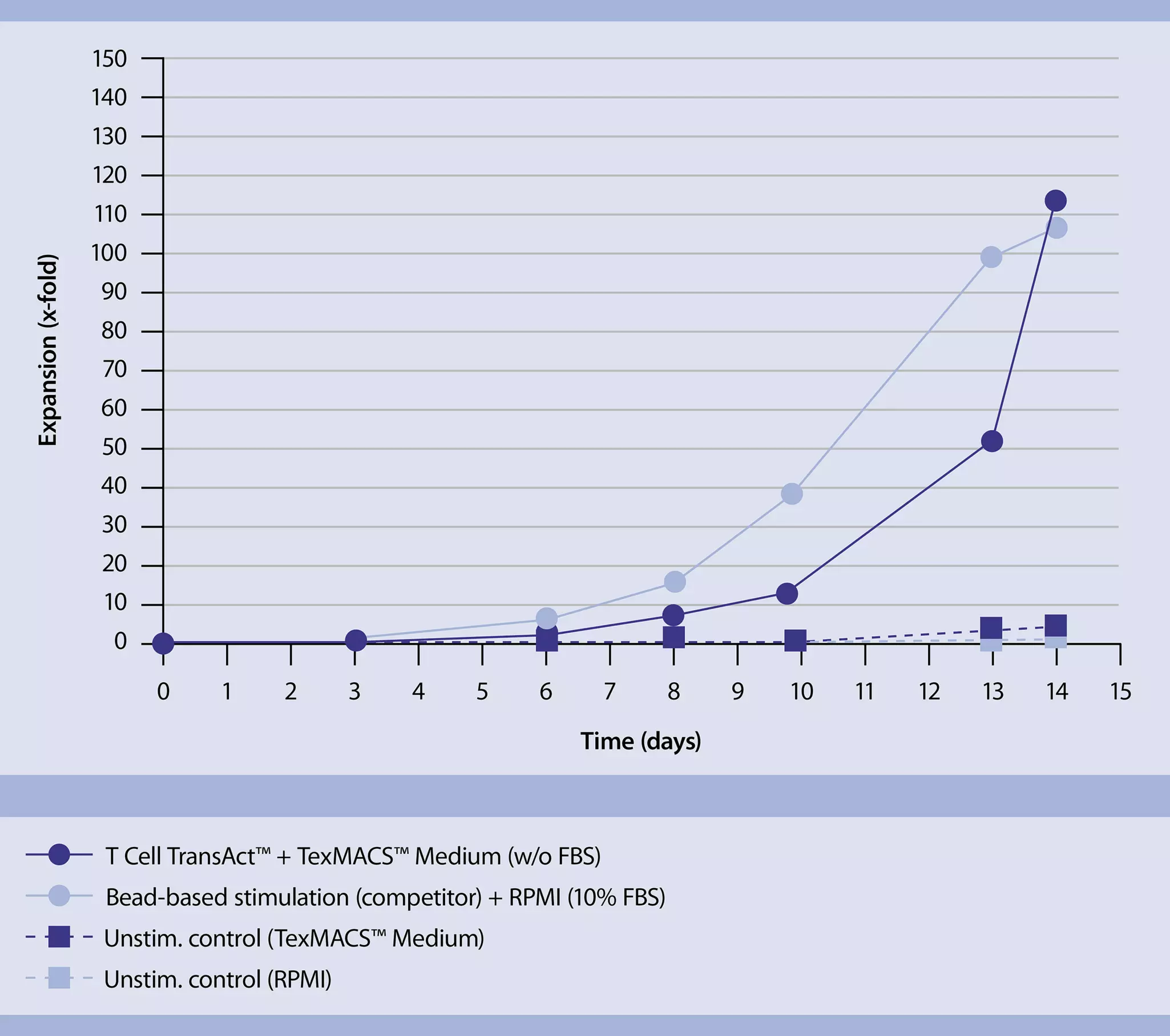
Figure 1
Comparison of T cell expansion after stimulation with T Cell TransAct and TexMACS™ Medium (serum-free) or a bead-based competitor product and RPMI (10% serum) was identical. Both media were supplemented with human IL-2 IS, Premium-Grade (50 U/mL).
view details
Figure 2
Human purified T cells were isolated using the Pan T Cell Isolation Kit and activated for 48 hours using the T Cell TransAct™ (titer 1:100) in TexMACS™ Medium supplemented with Human IL-2 (20 IU/mL). The negative control experiment was performed without adding the T Cell TransAct. Cells were fluorescently stained using CD25-PE and CD69-APC and analyzed by flow cytometry using the MACSQuant® Analyzer. CD4-VioBlue® was used for selection of T helper cells and CD8-VioGreen™ was used for selection of cytotoxic T cells. Dead cells and debris were excluded from the analysis based on scatter signals and propidium iodide fluorescence.


