

美天旎
130‑050‑201

CD14 MicroBeads, human 磁珠
CD14 MicroBeads can be used for the positive selection or depletion of human monocytes and macrophages from cord blood or PBMCs, as well as pleural, peritoneal, or synovial fluids or from various tissues, such as spleen and lymph node.

产品简介
Background information
The CD14 antigen belongs to the LPS receptor complex. Binding of antibody to CD14 does not trigger signal transduction since CD14 lacks a cytoplasmatic domain. CD14 is strongly expressed on most monocytes and macrophages and weakly on neutrophils and some myeloid dendritic cells.
Downstream applications
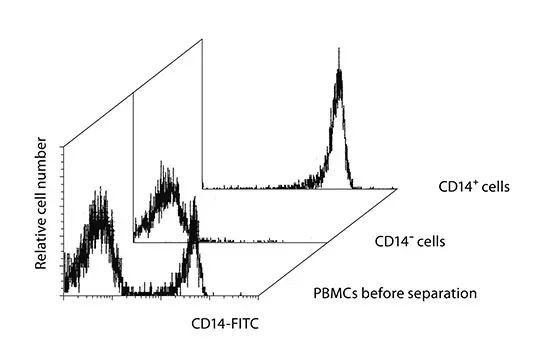
The most eminent use of monocytes isolated by MACS® Technology is their ex vivo differentiation into monocyte-derived dendritic cells (Mo-DCs). The excellent purity and recovery obtained by using CD14 MicroBeads provide a pure and consistent cell source (fig. 1). Contamination with unwanted cells (e.g. platelets) which may interfere with a controlled differentiation process is markedly reduced, and the isolated monocytes can be induced to differentiate into a homogenous population of immature as well as mature Mo-DCs. Dendritic cells generated from monocytes isolated by MACS® Technology have been used in many different fields of application.1-6
Apart from the generation of dendritic cells, monocytes are isolated, for example, for ex vivo generation of macrophages7,8 or for studies on cytotoxicity9 or migration10.
Columns
For positive selection: MS, LS, XS, or autoMACS® Columns. For depletion: LD, D, or autoMACS Columns.
产品参数
Figure 1
Separation of CD14+ cells from PBMCs using CD14 MicroBeads, an MS Column, and a MiniMACS™ Separator.
view details
Figure 2
Monocytes were isolated from PBMCs using CD14 MicroBeads and subsequently cultured for 7 days with IL-4 and GM-CSF to generate immature Mo-DCs and were, finally, cultured for additional 3 days with TNF-α for maturation. Mature Mo-DCs were stained for expression of CD1a, costimulatory molecules (CD80, CD86), CD83 and HLA-DR.


